
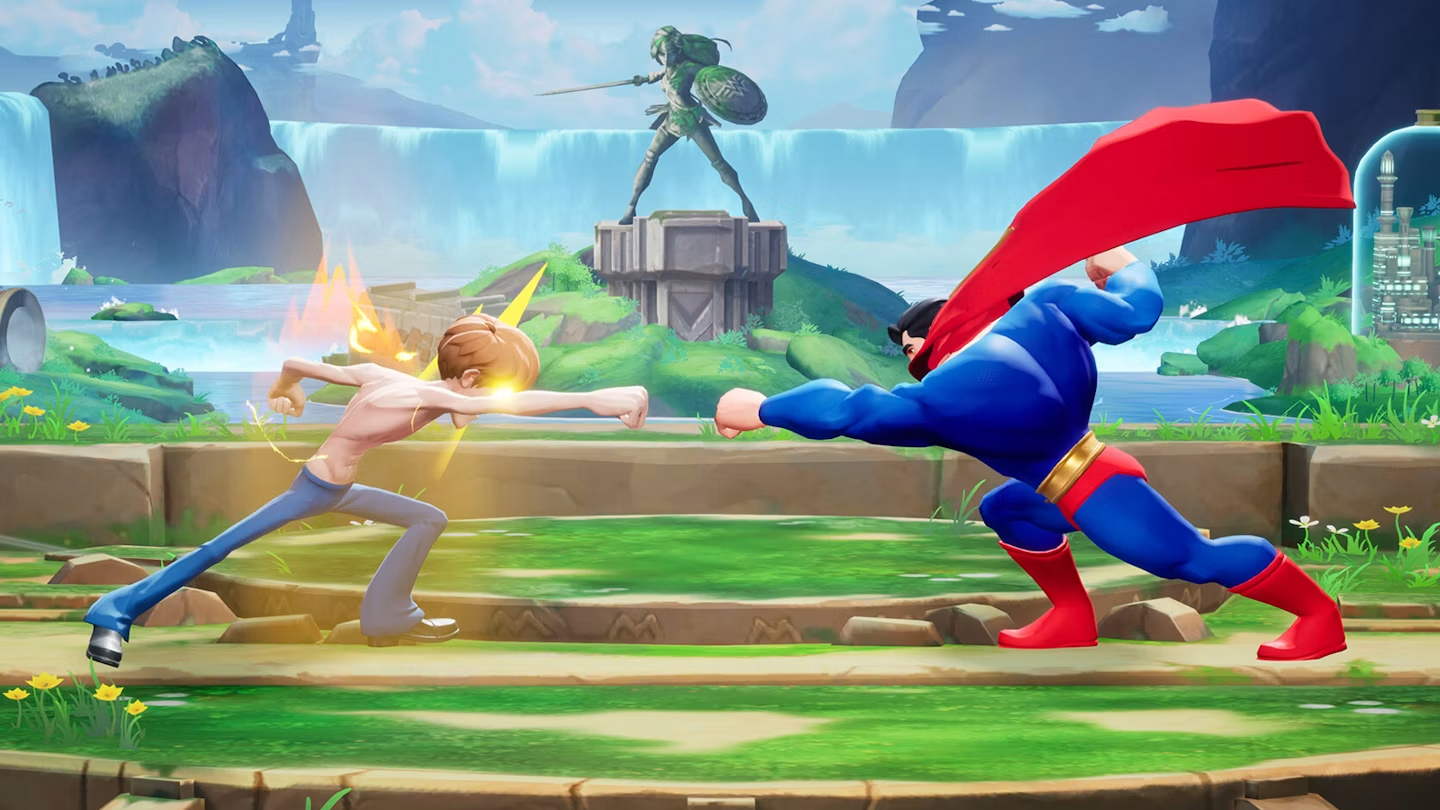
If you remember MultiVersus as the colorful platform fighter where Batman could fight Bugs Bunny, you may be surprised by how much the game changed after its initial launch. It looked simple on the surface, but its team-based combat, character abilities, perks, ringouts, and platform movement gave it more depth than a typical crossover brawler.
The bigger problem for many players is figuring out what MultiVersus actually became. Was it a serious competitor to games like Super Smash Bros., or was it simply a short-lived crossover experiment? And if you enjoyed it before, what should you know about its history, gameplay, characters, and eventual shutdown?
This guide explains the game from a player’s perspective rather than treating it as another character list. We’ll look at how its combat worked, what made its 2v2 design unusual, why some mechanics were harder to appreciate than expected, the mistakes that hurt new players, and what made MultiVersus stand out despite its short lifespan. If you’re trying to understand the game’s appeal—or why its community eventually disappeared—this is the practical overview you need.
What Was MultiVersus?
MultiVersus was a free-to-play platform fighting game developed by Player First Games and published by Warner Bros. Games.
Its central idea was easy to understand: characters from different Warner Bros. properties could fight each other in fast platform-based matches.
Its roster included characters and franchises such as:
- Batman
- Superman
- Wonder Woman
- Harley Quinn
- Bugs Bunny
- Tom & Jerry
- Shaggy
- Velma
- Finn
- Jake
- Steven Universe
- Garnet
- Arya Stark
- LeBron James
- Rick
- Morty
- The Joker
The crossover concept attracted immediate attention because it combined recognizable characters with mechanics inspired by competitive platform fighters.
But MultiVersus was not simply a traditional one-on-one fighting game.
Its biggest identity was 2v2 combat.
Why MultiVersus Felt Different
The easiest way to understand MultiVersus is to imagine a platform fighter where your teammate matters almost as much as your own character.
In a 2v2 match, winning isn’t always about beating the opponent directly.
You may instead:
- Interrupt an attack aimed at your teammate.
- Knock an enemy away so your partner can recover.
- Combine abilities.
- Protect a teammate from a ringout.
- Set up an opening for your partner.
- Control a section of the stage.
That creates situations that don’t happen in conventional fighting games.
For example, one player might launch an opponent into the air while the second player waits underneath. Instead of simply continuing their own combo, the teammate can intercept the opponent and extend the pressure.
This makes team awareness a major skill.
How MultiVersus Combat Worked
MultiVersus used platform-fighting fundamentals rather than traditional health-bar combat.
Players attacked until opponents accumulated enough damage to become easier to launch from the stage.
The basic loop was:
- Deal damage.
- Increase the opponent’s knockback vulnerability.
- Control stage position.
- Find a launch opportunity.
- Force the opponent beyond the blast zone.
This means damage and knockouts are related but not identical.
A character with a high damage percentage isn’t automatically about to lose. Position and recovery still matter.
Knockback Is the Real Endgame
One of the most useful concepts for beginners is understanding that damage is preparation.
Early in a stock, you can often take risks because your opponent is harder to launch.
Later, the same attack can become extremely dangerous because their accumulated damage makes knockback stronger.
So instead of thinking:
“I need to hit them more.”
Think:
“I need to create a position where my next strong hit matters.”
That mindset makes matches easier to read.
The Importance of Character Roles
MultiVersus characters weren’t designed to feel identical.
Different fighters encouraged different approaches.
Some characters were more comfortable at close range, while others specialized in controlling space or supporting teammates.
That distinction became especially important in 2v2.
Bruisers and Aggressive Fighters
These characters generally wanted to get involved directly.
They could pressure opponents and create openings through repeated attacks.
If you’re new to platform fighters, an aggressive character can be tempting because the game feels more straightforward.
The problem is that constant aggression can quickly turn into predictable behavior.
Tanks and Defensive Characters
Some characters could absorb pressure or protect teammates more effectively.
A tank-style approach can be particularly valuable in team matches because surviving longer gives your partner more opportunities.
Support-Oriented Play
One of MultiVersus’ more interesting ideas was allowing characters to contribute without simply trying to score every knockout.
A player who consistently protects their teammate can be more valuable than someone chasing every possible KO.
That is one of the game’s less obvious lessons:
A high personal knockout count doesn’t necessarily mean you played the better team game.
Why 2v2 Required Different Skills
Suppose you are playing a match and your teammate is fighting one opponent.
You have two options:
- Start your own fight with the other opponent.
- Help your teammate create a two-on-one situation.
The second choice can often be stronger.
But timing matters.
If you constantly abandon your opponent to help your teammate, you may give the remaining enemy complete freedom.
Good MultiVersus team play was therefore about temporary numbers advantages.
You wanted to create moments where your team had two players attacking one opponent, then quickly return to controlling your own side.
This sounds simple, but recognizing those moments in real time takes practice.
Movement Is More Important Than Beginners Expect
New players often focus almost entirely on attacks.
That can work for a few matches, but movement becomes critical as opponents improve.
You need to understand:
- Air movement
- Dodging
- Jump timing
- Recovery
- Platform positioning
- Fast repositioning
- Attack spacing
A player with average attacks but excellent movement can be extremely difficult to defeat.
Don’t Waste Your Recovery Options
One common mistake is using jumps, dodges, and recovery abilities too early.
If you use all your movement options while trying to attack an opponent, you may have nothing available when you actually get knocked off the stage.
This creates an important habit:
Always think about how you will return before committing to a risky aerial attack.
That single habit can prevent many unnecessary ringouts.
Perks and Build Choices
MultiVersus also included a perk system that allowed players to customize aspects of their characters.
Perks could influence how certain attacks, movement options, or team interactions worked.
For beginners, this can create a trap.
It is easy to spend too much time looking for the “perfect” setup before understanding the character itself.
A better approach is:
- Learn the character’s basic attacks.
- Understand your recovery.
- Identify your best neutral options.
- Learn which attacks launch opponents.
- Then experiment with perks.
Customization is most useful when you already understand what problem you are trying to solve.
Common MultiVersus Mistakes
Chasing Opponents Too Far
A player gets an opponent near the edge and immediately follows them offstage.
Sometimes this works.
Sometimes it results in your own ringout.
If you have already created a winning position, don’t turn it into a coin flip unnecessarily.
Using the Same Attack Repeatedly
An attack that works three times against a new player may fail completely against someone who has learned the pattern.
Mix up your timing and approach.
Ignoring Your Teammate
This is especially damaging in 2v2.
You don’t need to stare at your teammate constantly, but you should know whether they are:
- Being attacked
- Recovering
- Chasing an opponent
- In a strong position
- About to be eliminated
Treating Damage as the Only Objective
High damage is useful, but stage control often matters more.
If your opponent has high damage but remains safely in the center, you may still need to create the right launch opportunity.
What Made MultiVersus Appealing?
The game’s biggest advantage was accessibility.
The characters were familiar even to people who had never played a competitive platform fighter.
Someone could recognize Batman, Bugs Bunny, Shaggy, or Superman and immediately understand the basic fantasy:
“I want to see these characters fight.”
That lowered the barrier to entry.
The game also had enough mechanical depth for players who wanted to take combat more seriously.
The combination of recognizable characters and competitive mechanics was a strong idea.
What Didn’t Work as Well?
The game’s history was complicated by changes between its early open-beta period and its later full release.
Players who had already developed expectations around the original experience sometimes felt that the later version played differently.
That matters because multiplayer games depend heavily on community momentum.
A player can tolerate balance problems, matchmaking issues, or learning curves if they know a large and active community is waiting for the next match.
When that momentum weakens, every other problem becomes more noticeable.
A Unique Lesson From MultiVersus’ Lifecycle
One interesting lesson from MultiVersus is that a strong crossover roster cannot carry a competitive multiplayer game indefinitely.
Famous characters may get people to download a game.
They don’t necessarily give players a reason to stay.
Long-term retention depends on things such as:
- Combat quality
- Matchmaking
- Balance
- Progression
- Content updates
- Community trust
- Competitive depth
- Consistent player population
This distinction is easy to miss when looking only at the game’s initial popularity.
Another Overlooked Lesson: Team Games Need Better Communication
MultiVersus demonstrated how difficult it is to design a team-based fighting game for a largely solo-queue audience.
In a coordinated group, two players can plan their attacks naturally.
With random teammates, you may have completely different ideas about what the team should be doing.
One player may chase KOs while the other plays defensively.
One may rush constantly while the other waits for openings.
Neither player necessarily has bad mechanics, but the team can still fail.
That’s a broader multiplayer lesson: individual skill and team compatibility are separate things.
Is MultiVersus Worth Playing?
This depends heavily on what you’re looking for.
If you’re interested in its history, crossover concept, or platform-fighting mechanics, it remains an interesting game to study.
If you’re looking for a continuously active competitive service, the situation is very different because the game ultimately reached the end of its live-service run.
That distinction is important.
Don’t judge the game solely by its original popularity. Its current relevance is different from its launch-era relevance.
How to Get Better at Platform Fighters
If you’re coming from conventional fighting games, don’t assume all your habits transfer perfectly.
Platform fighters place much greater emphasis on movement and recovery.
A practical training routine is:
Step 1: Learn One Character
Don’t immediately rotate through the entire roster.
Choose one character and learn:
- Basic attacks
- Air attacks
- Recovery
- Dodges
- Launch options
- Safe approaches
Step 2: Stop Chasing KOs
For several matches, focus only on staying alive.
Practice recovering from bad positions.
Learn how opponents try to edge-guard you.
Step 3: Study Your Deaths
After a match, identify your most common reason for losing.
Was it:
- Falling offstage?
- Attacking too aggressively?
- Missing recovery?
- Ignoring your teammate?
- Repeating predictable moves?
Fix one problem at a time.
Frequently Asked Questions
What is MultiVersus?
MultiVersus was a free-to-play platform fighting game featuring characters from Warner Bros. franchises. Its combat supported both 1v1 and team-oriented 2v2 matches. Its focus on crossover characters and cooperative fighting helped distinguish it from traditional fighting games.
Why was MultiVersus popular?
The game’s recognizable roster made it easy for casual players to understand its appeal immediately. Characters from different franchises created matchups that fans naturally wanted to see. Its 2v2 combat also gave the game a distinct team-based identity.
Is MultiVersus a 2v2 fighting game?
2v2 was one of MultiVersus’ defining modes, although the game also supported other ways to play. Team matches required players to think about their partner as well as their individual opponent. Protecting a teammate and creating temporary two-on-one situations could be just as important as landing attacks.
How do you get better at MultiVersus?
Start by learning one character instead of constantly changing fighters. Focus on movement, recovery, spacing, and recognizing when an opponent is vulnerable. In 2v2, also pay attention to your teammate’s position rather than treating the match as two separate fights.
Why did MultiVersus shut down?
MultiVersus eventually ended its live-service operation after its player base and long-term service model failed to sustain the game. The game’s history involved significant changes between its earlier beta period and later release. Its shutdown illustrates how difficult it is to maintain a competitive free-to-play multiplayer game over time.
Conclusion
MultiVersus had an appealing idea: take familiar Warner Bros. characters and put them into a platform fighter where teamwork mattered as much as individual combat.
Its most interesting feature wasn’t simply the roster. It was the way 2v2 matches changed the meaning of fighting-game fundamentals. Positioning, recovery, protecting your teammate, controlling space, and choosing when not to attack could decide a match.
For players who experienced it, MultiVersus also provides a useful lesson about live-service games. A recognizable cast can attract attention, but long-term success depends on the quality of the complete player experience.
That combination of crossover appeal and competitive experimentation is what made MultiVersus memorable—even though its active lifespan ultimately came to an end.
